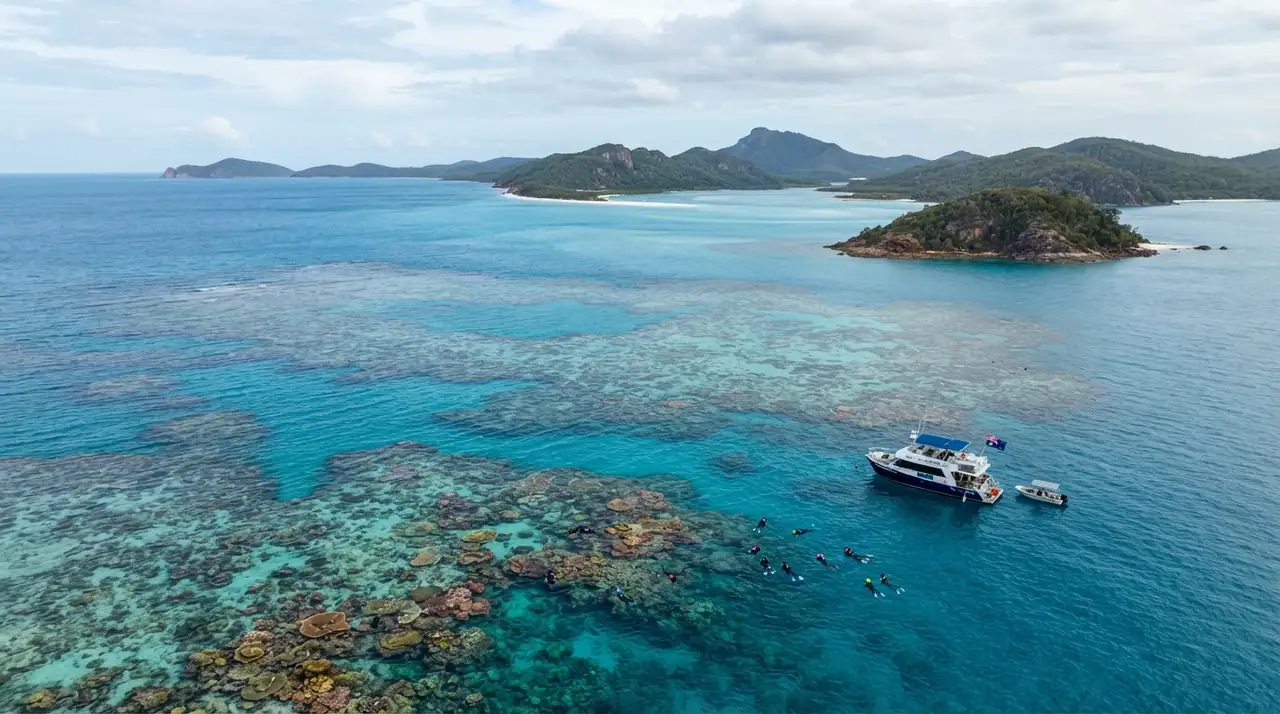
January in Great Barrier Reef — the hardest end of the year
Hardest · 4.1/10Days in January average 27°C (81°F) and humidity near 82% — front-load outdoor plans before the heat builds and treat the middle of the day as indoor time.
This is the year's wettest stretch at 483 mm, but with about 24 days with 6+ hours of sunshine it is not a total loss; an indoor fallback covers the risk.
That is 4.1/10 on the same scale — 12th of 12 months, versus 9/10 for the best month here.
Budget for low-season pricing, and crowds are light for this destination.
Pack the lightest breathable clothing you own, a hat, and more water than feels necessary, a proper rain shell rather than an umbrella, footwear you can get muddy.
If your dates are flexible, August is materially better in Great Barrier Reef — 4.9 points higher on the same scale.
February in Great Barrier Reef: expect compromises
Hardest · 4.2/10Days in February average 27°C (81°F) and humidity near 82% — front-load outdoor plans before the heat builds and treat the middle of the day as indoor time.
This is the year's wettest stretch at 362 mm, but with about 22 days with 6+ hours of sunshine it is not a total loss; an indoor fallback covers the risk.
That is 4.2/10 on the same scale — 10th of 12 months, versus 9/10 for the best month here.
Expect low-season pricing, and crowds are light for this destination.
Pack the lightest breathable clothing you own, a hat, and more water than feels necessary, a proper rain shell rather than an umbrella, footwear you can get muddy.
If your dates are flexible, August is materially better in Great Barrier Reef — 4.8 points higher on the same scale.
March in Great Barrier Reef — the hardest end of the year
Hardest · 4.2/10March averages 27°C (80°F) and humidity near 81%, so the practical pattern is early mornings, a long midday break, and evenings back outside.
319 mm makes this the wettest stretch of the year, though about 26 days with 6+ hours of sunshine still appear — keep an indoor fallback ready.
It scores 4.2/10 here, 11th of 12 months, against 9/10 in the destination's best month.
Plan for low-season pricing, with crowds are light for this destination.
Pack the lightest breathable clothing you own, a hat, and more water than feels necessary, a proper rain shell rather than an umbrella, footwear you can get muddy.
Flexible dates? August scores 4.8 points higher here — enough to change the trip.
April in Great Barrier Reef: expect compromises
Hardest · 4.6/10Trail conditions at 26°C (78°F) favour early starts and shaded routes in April; midday is for water breaks, not for exposed climbs.
This is the year's wettest stretch at 327 mm, but with about 27 days with 6+ hours of sunshine it is not a total loss; an indoor fallback covers the risk.
That is 4.6/10 on the same scale — 8th of 12 months, versus 9/10 for the best month here.
Expect low-season pricing, and crowds are light for this destination.
Pack light clothing, a hat and real sun protection, a proper rain shell rather than an umbrella, footwear you can get muddy.
If your dates are flexible, August is materially better in Great Barrier Reef — 4.4 points higher on the same scale.
May in Great Barrier Reef — reliably good (6th best month)
Good · 7/10May averages 24°C (75°F) — warm for the outdoors: start trails early, use shaded routes at midday, and carry more water than you think you need.
Rainfall runs 99 mm, so plan one flexible day in three; you still get about 29 days with 6+ hours of sunshine and 11.3 hours of daylight.
It scores 7/10 here, 6th of 12 months, against 9/10 in the destination's best month.
Figure on mid-season pricing, with crowds are moderate.
Pack light clothing, a hat and real sun protection, a packable rain layer, footwear you can get muddy.
Flexible dates? August scores 2 points higher here — enough to change the trip.
June ranks 2nd of 12 for Great Barrier Reef — one of the best windows
Best window · 8.6/10Trail conditions at 22°C (72°F) favour early starts and shaded routes in June; midday is for water breaks, not for exposed climbs.
Budget for roughly 56 mm of rain this month — a flexible day or two helps — with about 28 days with 6+ hours of sunshine and 11.1 hours of daylight to work around it.
On our climate-comfort scale this is one of the strongest months of the year for Great Barrier Reef at 8.6/10 (2nd of 12), just behind August at 9/10.
Budget for mid-season pricing, and crowds are moderate.
Pack light clothing, a hat and real sun protection, a packable rain layer, footwear you can get muddy.
July is one of the strongest months in Great Barrier Reef (3rd)
Best window · 8.6/10Trail conditions at 22°C (71°F) favour early starts and shaded routes in July; midday is for water breaks, not for exposed climbs.
Budget for roughly 63 mm of rain this month — a flexible day or two helps — with about 29 days with 6+ hours of sunshine and 11.2 hours of daylight to work around it.
On our climate-comfort scale this is one of the strongest months of the year for Great Barrier Reef at 8.6/10 (3rd of 12), just behind August at 9/10.
Expect peak pricing, and this is one of the busiest months here. You are paying the year's highest rates for the year's best conditions — book early or shift a few weeks either side.
Pack light clothing, a hat and real sun protection, a packable rain layer, footwear you can get muddy.
August: the best month of the year in Great Barrier Reef
Best window · 9/10August averages 22°C (71°F) — warm for the outdoors: start trails early, use shaded routes at midday, and carry more water than you think you need.
Rainfall runs 50 mm, so plan one flexible day in three; you still get about 29 days with 6+ hours of sunshine and 11.6 hours of daylight.
On our climate-comfort scale this is the top-ranked month of the year for Great Barrier Reef at 9/10 — the reference point every other month on this page is measured against.
Plan for peak pricing, with this is one of the busiest months here. You are paying the year's highest rates for the year's best conditions — book early or shift a few weeks either side.
Pack light clothing, a hat and real sun protection, a packable rain layer, footwear you can get muddy.
September in Great Barrier Reef — reliably good (4th best month)
Good · 8.2/10September averages 23°C (74°F) — warm for the outdoors: start trails early, use shaded routes at midday, and carry more water than you think you need.
Rainfall runs 59 mm, so plan one flexible day in three; you still get about 29 days with 6+ hours of sunshine and 12 hours of daylight.
It scores 8.2/10 here, 4th of 12 months, against 9/10 in the destination's best month.
Plan for mid-season pricing, with crowds are moderate.
Pack light clothing, a hat and real sun protection, a packable rain layer, footwear you can get muddy.
October holds up well in Great Barrier Reef — 5th best month
Good · 7.9/10Trail conditions at 25°C (78°F) favour early starts and shaded routes in October; midday is for water breaks, not for exposed climbs.
With around 41 mm of rain, any showers tend to pass through rather than settle in; about 31 days with 6+ hours of sunshine and 12.5 hours of daylight fill the rest.
That is 7.9/10 on the same scale — 5th of 12 months, versus 9/10 for the best month here.
Expect mid-season pricing, and crowds are moderate.
Pack light clothing, a hat and real sun protection, footwear you can get muddy.
November in Great Barrier Reef: mixed conditions, plan around the weather
Trade-offs · 6.7/10Days in November average 27°C (80°F) and humidity near 75% — front-load outdoor plans before the heat builds and treat the middle of the day as indoor time.
Budget for roughly 72 mm of rain this month — a flexible day or two helps — with about 30 days with 6+ hours of sunshine and 12.9 hours of daylight to work around it.
That is 6.7/10 on the same scale — 7th of 12 months, versus 9/10 for the best month here.
Expect mid-season pricing, and crowds are moderate.
Pack the lightest breathable clothing you own, a hat, and more water than feels necessary, a packable rain layer, footwear you can get muddy.
If your dates are flexible, August is materially better in Great Barrier Reef — 2.3 points higher on the same scale.
December in Great Barrier Reef — off-season conditions
Hardest · 4.3/10December averages 27°C (81°F) and humidity near 79%, so the practical pattern is early mornings, a long midday break, and evenings back outside.
395 mm makes this the wettest stretch of the year, though about 26 days with 6+ hours of sunshine still appear — keep an indoor fallback ready.
It scores 4.3/10 here, 9th of 12 months, against 9/10 in the destination's best month.
Figure on low-season pricing, with crowds are light for this destination.
Pack the lightest breathable clothing you own, a hat, and more water than feels necessary, a proper rain shell rather than an umbrella, footwear you can get muddy.
Flexible dates? August scores 4.7 points higher here — enough to change the trip.